That faint tingling in your hands after 55? There's more behind it than age.
For the woman who has weathered every season, and is ready to walk into the next one with ease, dignity, and without that strange tingling she's learned to ignore.
There is a moment, perhaps you know it well, that arrives sometime in your late fifties or early sixties. You wake one ordinary morning, swing your feet to the floor, and there it is again — that faint tingling, that little pins-and-needles greeting from a part of you that used to feel nothing at all.
It is not dramatic. It is not catastrophic. It is, simply, the beginning of a quieter conversation between you and your hands, your feet, your fingertips. A conversation that asks you to pause, to notice, to listen.
For some of us, that conversation grows louder. The buttoning of a blouse takes a moment longer than it once did. The teacup is held with a quieter, more careful grip. The evening walk that once felt automatic now begins with a small pause, a small adjustment, a small act of attention.
And here is the thing nobody quite warns you about: it is not the sensation itself that wears at the spirit. It is the quiet narrowing of one's confidence around it. The cup of tea one passes on. The shoes one chooses for steadiness rather than for beauty. The grandchild one holds a little less tightly than one would like.
And if that tingling or unsteadiness is new, persistent, or getting worse, it is worth seeing your doctor first — sensations like these can have causes worth ruling out, from vitamin levels to blood sugar.
We do not write to you with miracles. We have read enough wellness copy to be suspicious of those.
But we do write to share something we have come to take seriously, after a great deal of reading, and a great deal of asking the wrong questions before arriving at better ones. The body, even now, perhaps especially now, is not finished speaking with you. And the conversation can change.
· · ·
This is the kind of plain letter we wish more people were handed before they spend years guessing.
A question turned around
If you have dealt with this, the long inventory is probably familiar. Magnesium at night. Vitamin B12 in the morning. Gentle stretches recommended by a physiotherapist. A small mountain of supplements gathering dust on the kitchen windowsill, each one promising something quiet, each one delivering very little.
The assumption underneath it is almost always the same: that the tingling, the small numbness, the occasional sharp little reminder in fingers and toes are simply nerves behaving as nerves do at this age — that nothing can be done about them, only quietly endured.
What's worth considering is rarely a new supplement on top of the others. It is a different question altogether.
What if it isn't really about the nerves themselves? What if it's about what's inside them, and what they've been quietly missing?
That is the question this letter is about.
Two compounds. One quiet idea.
What the research papers describe, put in plainer language, comes down to this.
The small fibres in our hands and feet, the ones that carry sensation back to us so we can hold a teacup or feel the grass underfoot, are extraordinarily delicate. They depend on a steady supply of two particular things: a way to protect themselves from the daily wear of oxidation, and a way to remain properly nourished by the nutrients our food once provided generously, and now provides less reliably.
Modern research has gathered, quietly, around two compounds that appear to support both of these needs at once.
The first is called Alpha Lipoic Acid, or ALA for short. It is a molecule that exists naturally in small amounts in food. What makes it unusual, researchers say, is that it appears to work in both the watery parts of our cells and the fatty membranes of those cells, including the membranes that wrap around our nerve fibres themselves. Most antioxidants only reach one or the other. ALA reaches both. Some scientists call it a "universal" antioxidant for this reason.
The second is called Benfotiamine, a quiet, more easily absorbed form of Vitamin B1. The regular B1 you might find in any high-street supplement struggles, frankly, to reach the places it matters most. Benfotiamine is built differently. It is fat-soluble, which means it can pass into the very tissues (including the nerve tissues themselves) where ordinary B1 simply does not arrive.
Studies suggest that, taken together, these two compounds may help support the normal, calm functioning of the small nerves in our hands and feet. The research is hedged, as research properly is. Associated with. May support. Has been observed to. These are the careful phrases researchers use when something interesting is happening, while they want to be honest about the limits of certainty.
Much of this research has looked specifically at nerve symptoms linked to diabetes — one more reason it is worth knowing the cause of your own.
In the studies, where a change was reported, it tended to build gradually — over weeks, not overnight.
Not a miracle. A small, steady change, like the way a room grows warmer without you noticing when the sun moves through the window.
A small bottle, a small American company
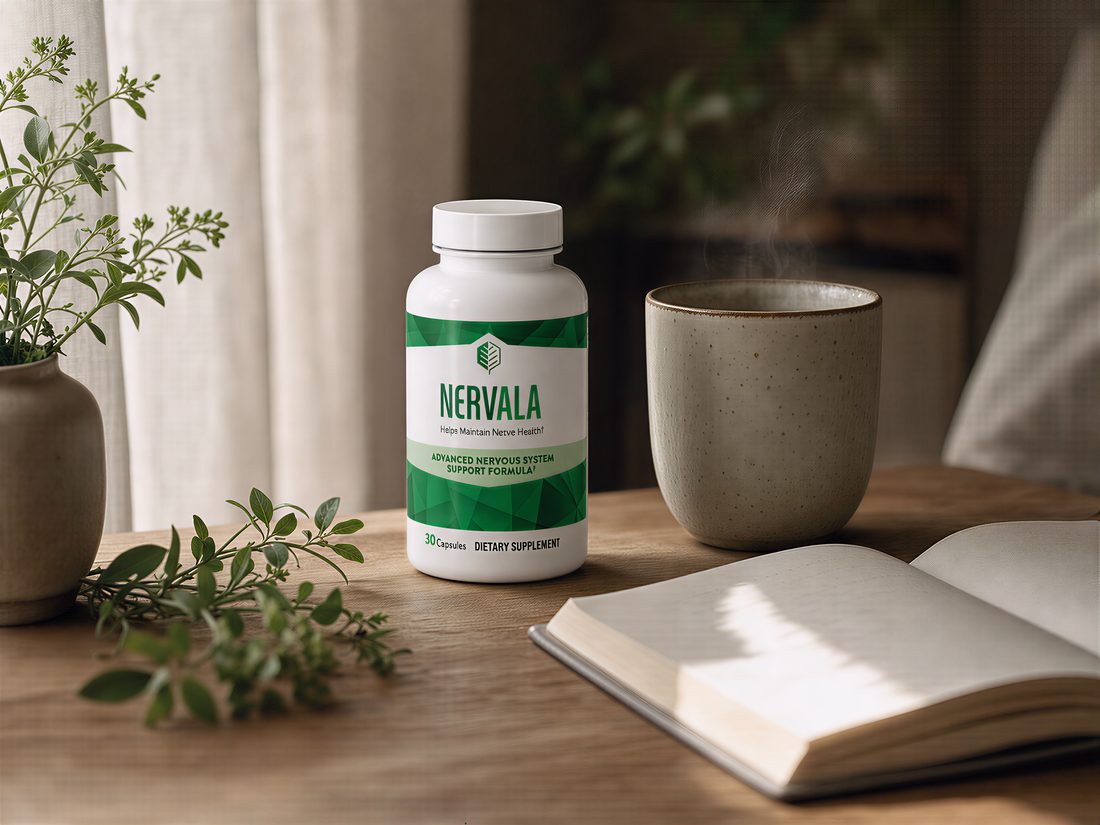
The bottle is small. Plain. Green and white.
It is called Nervala. It is made by a small American company called Barton Nutrition, and was formulated by a functional medicine specialist named Dr. Scott Saunders, who has been writing about nerve health for many years and wanted something simple, with the right doses, and nothing else.
The label is unusually short.
Two ingredients. That is all.
Alpha Lipoic Acid — 600 mg. Benfotiamine — 75 mg.
No fillers. No proprietary blends. No long Latin words to research afterwards. Just the two compounds described above, in the precise dosages researchers have studied most.
The protocol is equally plain: one small capsule, with water, in the morning. That's all.
What we find quietly reassuring about this bottle is the plainness of it. The absence of theatre. The narrow promise, kept narrow.
What the research suggests about the first weeks
We will not pretend the first week is dramatic. In the trials, it rarely is.
The studies on Alpha Lipoic Acid and Benfotiamine point to a cumulative effect — something that builds slowly rather than arriving in a single morning. Where improvements in symptoms like tingling, numbness and burning were measured, they tended to appear over a number of weeks, not days, and they were modest rather than miraculous.
It is also honest to say that study results are averages. Some people improved meaningfully; others noticed little. Individual response varies — which is exactly why the year-long guarantee below matters: it lets you find out on your own nerves, without betting much on the average.
So the realistic expectation is not a switch flipping. It is the possibility of a small, gradual change over the first weeks — the kind you might only notice in hindsight, the way a room grows warmer without you noticing when the sun moves through the window.
A quiet thought on what came before
If you are like most people dealing with this, you have probably tried other things first. Here is the honest, mechanistic reason a two-compound approach is different from what came before.
It is not that the other things were bad. They were simply insufficient.
The ordinary Vitamin B1 in most supplements struggles to reach nerve tissue at all. Much of it is absorbed by the gut and excreted without arriving where it is needed. Benfotiamine arrives.
Most antioxidants work only in the water of the cell, or only in its fat. ALA works in both. The small nerve fibres need both.
Magnesium, fish oil, B12 by itself, evening stretches: none of these are mistakes. They are just looking at parts of the question. The two-compound approach in Nervala, in the doses researchers have actually studied, addresses the question at the level of the cell itself.
That is what "the question turned around" means in practice. It is not about trying harder. It is about giving the small fibres what they have, quietly, been missing.
The bottle is plain. The formula is two ingredients. There is no theatre. And the logic is at least worth understanding before you write the symptoms off as "just age."
An honest word about price
People often brace themselves to pay a great deal for relief like this.
Nervala costs less than most expect for a nerve-support formula.
The single bottle is sixty-seven dollars. The three-bottle bundle brings the per-bottle price down to fifty-nine. The six-bottle bundle — what the company recommends — is forty-nine dollars per bottle, with free shipping in most countries.
For comparison, a decent pair of reading glasses tends to cost more.
But more importantly: it comes with something most supplements do not.
A three hundred and sixty-five day money-back guarantee.
A full year. The longest we have seen attached to any small bottle of anything. If, after a year, the bottle has not done for you what the research suggests it might, you write to the company and you receive a refund. No theatre. No phone tree. They simply send the money back.
We think the existence of a year-long guarantee tells you something about what the company believes about their own quiet product.
If you want to read more — or simply see the small bottle for yourself — this is the page Barton Nutrition publishes.
365-day money-back guarantee · Free shipping on bundles
A small FAQ, before you decide
"How long until I notice anything?"
Clinical studies on ALA and Benfotiamine generally report measurable effects somewhere between the second and the sixth week. The effect is cumulative — it builds quietly, rather than arriving in a single morning.
"Is it safe with the things I already take?"
The two ingredients are nutrients found in food. They are generally considered well-tolerated. That said: if you take prescription medication of any kind — particularly anything that affects blood sugar — please show the bottle to your physician before starting. This is a small letter, not medical advice.
"What if I have already tried everything?"
Most people who look into this have already tried a long list. The two-compound approach targets something at the cellular level that magnesium, B12 or stretches on their own do not.
"Why have I not heard of this before?"
Because Barton Nutrition is a small company. It does not advertise on television. Its founder, Dr. Saunders, prefers — quite stubbornly — to keep things quiet. This letter is one of the few ways people find their way to it.
"What if it does not work for me?"
You return the unused portion to Barton Nutrition any time in the next three hundred and sixty-five days, and they refund you in full. The company's contact information is listed on the order page if you would like to see it for yourself before deciding.
If this is your story too
If your hands or feet have grown a little quieter than you would like, or a little louder in ways you would rather they were not, this is the small letter we keep publishing.
It is not a programme. It is not a regimen.
It is a small green bottle. Two compounds. One capsule a day. And three hundred and sixty-five days to decide whether it does for you what the research suggests it might. That full-year guarantee is the reason it costs you nothing to find out.